
Have you ever found yourself looking at the world around you and asking questions like:
If so, then you’re thinking like a scientist! In science, you can ask questions, test your ideas, uncover answers, develop solutions, and share your discoveries.
Developing a research project can feel very daunting though, even for experienced scientists. To help you get started, check out these ten steps to a research project:
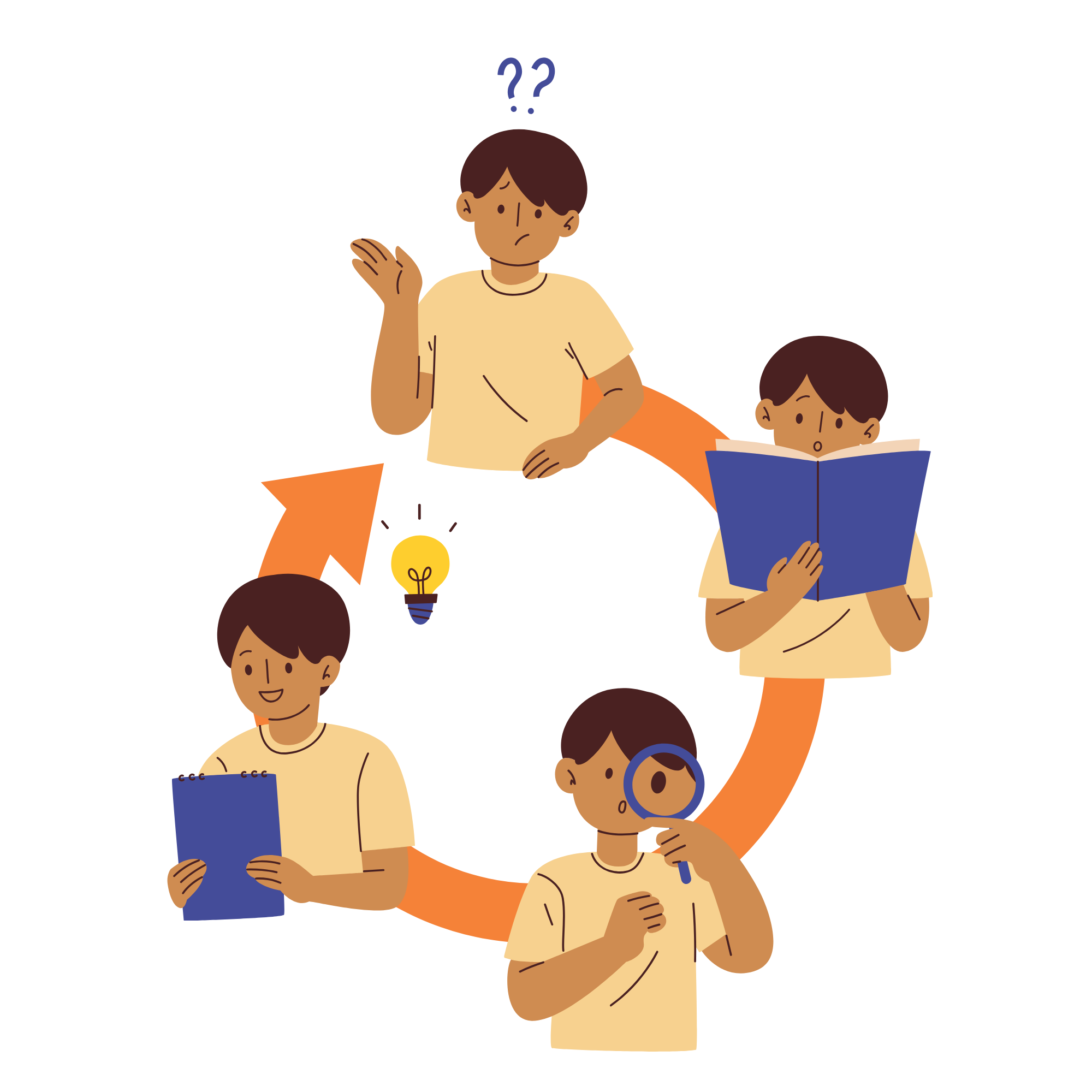
Every research project starts with a question. Ask yourself: What am I curious about? What do I want to discover? What problem do I want to solve?
A good research question is clear, specific, and can be tested by doing experiments or analyzing data. For example, instead of asking “Does music affect people?” you could ask, “Does listening to classical music while studying improve knowledge retention?”
At eiRxiv, we also find the best research comes from genuine curiosity, not just a desire to get a publication. So, get curious, ask questions, and find what interests you!
As you’re developing your research question, it’s important to learn what other scientists already know about your topic. Understanding the current research can help you focus your research or uncover new questions that don’t have answers!
Scientific journal articles are the best place to find your information, though textbooks, science magazines / news articles, preprints, and encyclopedias can also be useful. Other sources–like Wikipedia, blogs, social media, etc.–can spark your curiosity or point you toward more scientific resources, but we don’t recommend using them as primary sources for scientific knowledge.
The following sites can help you access scientific journal articles:
How to choose your sources
Choosing good, trustworthy sources of scientific information provides a solid foundation for your research. If your research is based on faulty or biased information, your conclusions may not be accurate, other scientists may not trust your results, or your work could mislead readers.
Good sources are:
✅ Scientific: written by scientists or other experts in the field, and accepted or verified by other scientists/experts
✅ Unbiased: written to test a hypothesis or show data, not to prove a point, sell a product/service, or support an agenda
✅ Factual: based on reliable data that has been properly analyzed and interpreted, not based on opinions
✅ Current: reflecting the most up-to-date understanding of the field and incorporating any new discoveries or changes
Develop a hypothesis that is clear, measurable, and testable before you start your experiments. Then, stick with it!
A good hypothesis is the foundation that will help you design your experiments, decide what to measure, and figure out how to analyze your data.
Before you write your hypothesis, read our guidelines for creating a great hypothesis.
With your question and hypothesis in hand, you can then plan how you will find the answer – in other words, you design your experiments.
For your experiments, think about what you will manipulate (the variable) and what you will measure (the outcome). For example, if your research question is about music and memory, your variable could be the type of music, and your outcome could be the number of correct answers on a memory test.
To make sure your data are reliable, you will need to repeat your experiment several times. A good rule of thumb is at least three (3) trials for each condition (called replicates), though we recommend more if you have the time and resources.
As you plan your experiments, don’t just think about what data you’ll collect–think about how you’ll analyze it. Deciding how you’ll analyze your data at this early stage helps make sure you have good experimental controls and enough replication (repeats of your experiment) to do the statistical analysis you want.
Use our Statistics Guide to help you plan how you will collect and analyze your data before you start your experiment.
During planning, we also recommend you find an adult mentor to help you plan, conduct, and analyze your experiments. They can provide key support as you do your research!
Scientists must make sure their research is safe and permitted – both for themselves, and for any humans or animals involved in their research.
At eiRxiv, we prioritize the safety of our student researchers and their community. Our safety and research permission guidelines are based on the guidelines for the Intel International Science and Engineering Fair (ISEF).
Visit Get Permission for Your Research to see whether or not you need permission for your research (more research needs it than you might think!). This page also guides you through how to get the necessary permissions and make sure your research is safe and ethical.
After planning, it’s time to do the experiment! Collect data carefully and accurately document everything you observe, even if you don’t think you need that extra data.
If experiments don’t go as planned, you may need to repeat, rethink, or redesign them. This is ok, and happens all the time in science!
Once you have collected your data, you can organize your data into tables, graphs, or figures. so it’s easier to see patterns or differences. Use statistics you planned to determine whether your results happened by chance, or because you’re observing a consistent pattern.
See Write Your Manuscript for more guidance on how to describe your data and create figures and tables.
Now you have your data and can think about what your results mean.
Ask yourself questions like: Did the results match what I thought would happen? Did anything surprise me?
If your experiment didn’t work as planned, that’s okay! That’s normal in science. What matters most is what you learned from your project. You can suggest ways to improve the experiment or come up with new questions to explore. That’s how professional scientists make discoveries: by learning from both expected and unexpected results. Every experiment is a chance to discover something new, even if the results aren’t what you expected.
See Write Your Manuscript for more guidance on how to interpret your data.
Decide who you want to share your research with, and how you want to communicate your idea with them. Sharing your science can take many forms: conversations, presentations, social media, posters, scientific journal articles, preprints, and more!
As you get feedback from the people you share with, consider how you could improve your research or how you communicate it.
Hopefully by now you’ve caught the science bug, and are excited to keep asking questions and investigating! This could mean extending your previous research or coming up with an entirely new question.